
Acoustic imaging
The precise location of noise sources is a central issue in industrial acoustic studies. On complex sites, where several pieces of equipment are operating simultaneously, it can be difficult to identify the source actually responsible for the nuisance using conventional measurement methods.
Acoustic imaging makes it possible to visualize noise and quickly identify the primary noise sources. SIM Engineering has two acoustic antennas dedicated to this technology, offering a high-performance approach to the diagnosis, assessment, and acoustic optimization of industrial facilities.
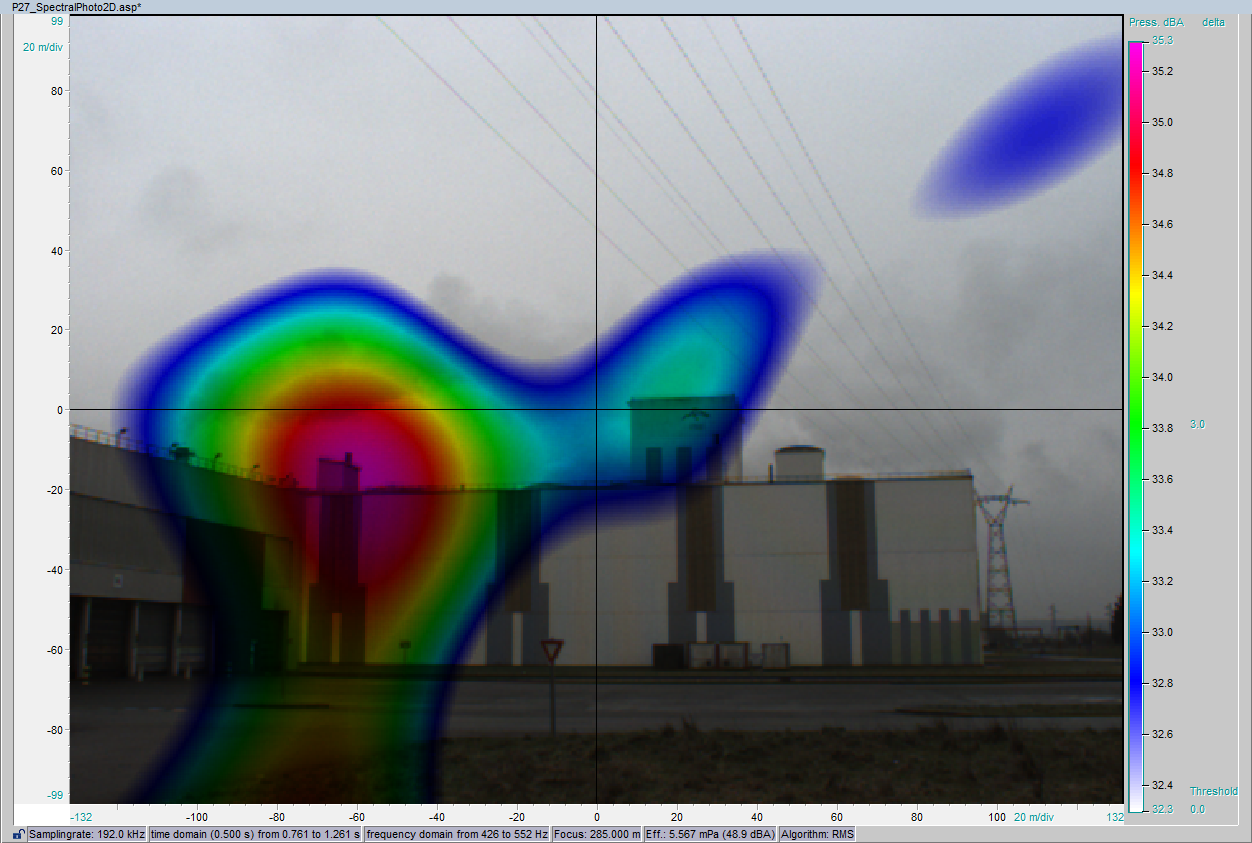
Principle and benefits of acoustic imaging
Acoustic imaging is based on the use of multi-microphone antennas combined with advanced processing algorithms. These systems can reconstruct a spatial image of the sound field and superimpose acoustic levels on a visual image of the site or equipment under study.
This technique makes it possible to pinpoint the origin of noise, even at a distance, and to distinguish several active sources simultaneously. It is particularly well suited to industrial environments with complex sound propagation and multiple acoustic emissions.
A powerful diagnostic tool for industrial sites
SIM Engineering uses acoustic imaging to analyze industrial sites, technical facilities, and noisy equipment. Measurements can be taken remotely, from up to 300 meters away, without requiring direct access to the sources.
This capability allows us to work in hard-to-reach areas during normal operations, while ensuring the safety of personnel and maintaining operational continuity. Acoustic imaging has thus established itself as an effective solution for rapid diagnostics and targeted assessments.
Quick to implement and effective in the field
One of the main advantages of acoustic imaging is how quickly it can be deployed. Measurement campaigns can be carried out in a short amount of time, with minimal site preparation.
This approach provides an immediate first reading of acoustic phenomena, and enables us to rapidly direct further investigations if necessary. It is particularly relevant in the case of urgent problems, neighborhood complaints or diagnostic phases prior to a full acoustic study.

International intervention

Acoustic design office

Certified experts
Rapid identification of dominant sources
Acoustic imaging makes it possible to visually identify the primary source of noise among all operating equipment. This immediate identification saves a significant amount of time in acoustic analysis.
It helps avoid misdirected corrective actions and allows efforts to be focused on the equipment that is actually contributing to the noise. This approach optimizes acoustic treatment costs and improves the effectiveness of the solutions implemented.
Advanced spectral analysis and complementary images
Beyond simple spatial localization, SIM Engineering performs complete spectral acquisition of the measured signals. Frequency analysis enables us to produce complementary acoustic images by frequency band or around specific lines.
This detailed analysis capability is particularly useful when searching for sources with pronounced tonal signatures, such as fans, motors, gears or rotating equipment. It makes it possible to differentiate between several noise mechanisms, and to precisely orient source reduction actions.
Assessment of noise impact at measurement point
Data from acoustic imaging also make it possible to assessthe noise impact of the source located at the measurement point. This information is essential for prioritizing acoustic contributions and understanding the actual role of each piece of equipment in the overall measured noise level.
This quantitative approach complements visualization and makes acoustic imaging part of a rigorous engineering approach, compatible with regulatory requirements and acoustic impact studies.
Wide frequency band analyzed
The acoustic sensors used by SIM Engineering cover a wide frequency range from 100 to 7,000 Hz, suitable for most industrial applications. This frequency range allows for the analysis of low-frequency noise associated with large mechanical installations, as well as higher-frequency noise generated by fluid flow, whistling, or mechanical defects.
This broad frequency coverage guarantees a complete view of acoustic phenomena and a reliable interpretation of the mechanisms involved.
Integration into overall acoustic studies
Acoustic imaging results are fully integrated into SIM Engineering’s other services. They are used to characterize sources, define acoustic power levels and calibrate numerical models.
This synergy improves the accuracy of 2D and 3D acoustic models, enhances the reliability of calculations regarding the impact on the surrounding area, and enables the precise sizing of the acoustic mitigation measures to be implemented.
Technology at the service of technical decision-making
Acoustic imaging is a particularly effective decision-making tool for manufacturers. It makes complex phenomena visible, facilitates understanding of acoustic issues and helps to secure technical choices.
By combining field expertise, cutting-edge instrumentation and advanced acoustic analysis, SIM Engineering supports its customers in the sustainable management of their noise emissions, from diagnosis to the implementation of high-performance solutions.
Do you have a question or an acoustic project?
Acoustic treatment, noise problems, environmental adaptation, compliance, rental, ...
Contact us!